
7 May 2021 · 10 min read
Looking for a CFO, or thinking about hiring one? We have put together a practical guide to help you find, attract and interview the best CFO candidates.

Looking for a CFO? Or thinking about hiring one? We have put together a guide to help you find the right person.
In this article, we cover the most important points to make your hire a success. To do so, we answer these 5 questions in detail:
- When should you hire a CFO?
- What are the key hard skills for a CFO?
- What does the role of "Chief Financial Officer" cover?
- Where can you find your CFO?
- How should you run your interviews?
For reference, in French-speaking countries the role is often called DAF (Directeur Administratif et Financier), while in practice the English term CFO (Chief Financial Officer) is also widely used.

When should you hire a CFO?
Before you start looking into hiring a CFO, it is important to determine whether your company actually needs one. Several factors come into play when answering this question:
- the company's annual revenue;
- the complexity of the accounting;
- the number of employees.
However, there is no hard and fast rule. It is difficult to set a threshold above which you should hire a Chief Financial Officer. Based on the factual information available to you, it is up to you to decide whether the time has come.
What's more, the choice is no longer simply between having a CFO or not. With the rise of part-time CFOs and “remote CFOs”, there are alternatives. They offer more flexible solutions that are better suited to smaller organizations.

7 mistakes to avoid for successful reporting
❌ Every finance professional has made a reporting mistake at some point. Drawing on our 10,000+ client companies, we have gathered the most common mistakes for you.
✅ Never make a mistake again by downloading this free ebook.

What are the key hard skills for a CFO?
You have started your search for the perfect candidate for your company. Now it is time to look at the key skills of the CFO you are looking for.
There are two types of skills:- hard skills (i.e. the technical skills required);
- soft skills (i.e. interpersonal and emotional intelligence).
For a successful hire, it is vital that the candidate you recruit has both types of skills. However, we have chosen to focus on hard skills. Why? Because they are the pillars of your CFO's expertise, and your CFO must be an expert in their field.
The hard skills of CFOs can be grouped into three main categories:- technical know-how;
- an appetite for digital;
- an understanding of your company's business model.
Technical know-how
It goes without saying that candidates for the CFO role must excel at financial management. The essential skills for your future CFO include:- overseeing accounting;
- building budgets;
- producing monthly reporting;
- monitoring cash;
- preparing forecasts;
- managing administration;
- presenting results.
This technical knowledge is essential because it lies at the heart of the CFO role.
An appetite for digital
Your Chief Financial Officer sits at the crossroads of business strategy, financial management and technology. Technology is now one of the main drivers of growth. A recent study by Deloitte shows that there is a strong link between a company's financial success and its level of digital maturity. By “digital maturity”, we mean how deeply digital technology is integrated into a company. The study shows that companies with a high level of digital maturity see revenue growth three times higher.
In addition, companies' IT spending increased by 79% following the COVID-19 pandemic (Statista study by K. Mlitz). There is no doubt about it: digital is becoming ever more embedded in our businesses. This is particularly clear when you consider how widespread remote work has become. According to a survey by ASAP.be, 90% of respondents want to keep working from home 1 to 3 days a week once the health situation stabilizes. This trend is therefore unlikely to reverse.
The role of Chief Financial Officer is itself affected by this digitalization. IT now plays a major part in CFOs' daily work. Among the major technological advances, Accenture's report CFOs: The new digital apostles by Accenture cites:- mobile devices and other connected objects, which provide increasingly rich data to feed your predictive analyses;
- advanced analytics, which automatically generate updated revenue forecasts and help identify untapped revenue opportunities;
- the cloud, which makes data accessible quickly and from anywhere.
- blockchain
 ;
- artificial intelligence;
- augmented reality;
- cybersecurity;
- robotics.
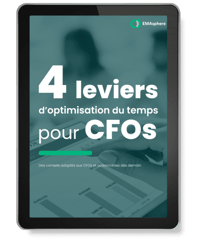
How can you stop racing against the clock as a CFO?🤔
⏰.Discover 4 time-saving levers for CFOs in a free ebook.

 EY defines blockchain as: “A way of structuring data without the need for a central authority. A blockchain is a distributed database that hosts a continuously growing number of records. The database stores records in blocks rather than collating them in a single file. Each block is then “chained” to the next block in a linear, chronological order using a cryptographic signature, so the data cannot be altered and any attempt to change it is visible to all participants.”
Let's take an example: blockchain is often associated with digital currency. Digital currency is a transaction system that does not require a central authority. In that respect, it differs from the euro or the dollar. These technologies are revolutionizing the world of finance. That is why CFOs have every reason to keep an eye on blockchain.
The innovations mentioned in this Accenture article are all topics your Chief Financial Officer should be eager to explore. To meet your company's needs, your CFO is expected to become a Digital CFO. To get there, they must be at the heart of the digital transformation.
Understanding your business model
When it comes to hard skills, there is one last point to consider: knowing and understanding your company's business model. The business model affects the entire company, including the CFO role. That is why it is essential that your CFO masters the specifics of your business model.
One of our tips for hiring the right CFO is not to confuse understanding the business model with industry experience. On this subject, the specialist site CFO.com explains: “People tend to confuse industry and business model. What matters is understanding the business model. Hiring based on industry knowledge is too restrictive.”
To understand a company's business model, a CFO has several sources of information. Experience is not the only thing that counts. For example, CFOs who want to grow will make the most of their professional network to quickly acquire the knowledge they need for their role.

What does the role of "Chief Financial Officer" cover?
So as not to reduce the CFO role to technical expertise, we will look at three facets of the job:- the role of partner;
- the role of analyst;
- the role of manager.
A partner
Financial management is a cross-functional role. That is why it is important for the CFO to act as a partner to your various departments.
On the one hand, because the CFO is traditionally the CEO's strategic partner. The CEO bases many strategic decisions on the indicators provided by the CFO. It is therefore crucial that the CFO is able to communicate the most relevant information at the right time.
On the other hand, because the CFO also needs to be close to the company's other departments. This proximity allows the CFO to make sure their policies are applied correctly. It also makes it easier to receive feedback and make the best choices. What's more, by knowing the company well, the CFO will be able to identify the best investments to make.
An analyst
Today, most companies can collect financial, sales and HR data. But an abundance of data is a double-edged sword. It can boost your company's growth, or become dead weight. What makes the difference between the two scenarios? The quality of your data analysis.
That is why it is essential that your CFO knows how to make your data speak. This analytical skill will help you improve the quality of your budgeting and your cash flow forecasts.
A manager
Your CFO also needs to be a good team manager. In today's companies, leadership is as valuable as financial skills. The qualities of a Chief Financial Officer are reflected in those of their team. It is up to CFOs to build a team with the right skills and knowledge. Once those teams are in place, CFOs are expected to show leadership to motivate and support them.
In addition, your future Chief Financial Officer must be a person of action. They are the one who will translate the CEO's strategic choices into concrete decisions. They will therefore need to manage their various projects masterfully to bring the company's strategy to life.
Where can you find your CFO?
You now know the criteria for hiring the right CFO. You are ready to put them into practice! Finding a Chief Financial Officer is no easy task. Good CFOs are always in demand. Nevertheless, there are several ways to get in touch with them.
Through LinkedIn, the go-to network
LinkedIn is an important social network for CFOs. It can therefore be a key ally in attracting and/or reaching out to candidates.
On the one hand, LinkedIn has a “filter” feature that lets you quickly find interesting profiles.
 Tip: Refine your search so that you never have more than 1000 results. This will help you get the most out of the platform. By default, LinkedIn limits your search results to the 1000 most relevant profiles. It is therefore in your interest to refine your search criteria until the number of results drops below 1000.
On the other hand, LinkedIn also lets you post a job offer. This is a paid service, but it ensures your ad reaches a large number of potential candidates.
Through word of mouth
To find your CFO, rely on word of mouth. You and the people around you may know skilled professionals who could be a good fit for the role. By hiring someone from your network, you increase the chances that the candidate will be a good fit for the company. That is why it is important to talk about your CFO search with the people around you.
There are 3 networks you should not overlook:- Your own: university acquaintances, former colleagues, partners…
- Your employees' network: your colleagues may know some interesting profiles.
- Your board of directors' network: directors often have close ties with several companies. They therefore have a very wide network that you can use to your advantage.
Through recruiters
Searching for a CFO yourself can be a long and stressful process. That is why delegating this work to an external provider can be a good option. Instead of spending your time contacting potential candidates, entrust this work to a team of qualified professionals. Admittedly, this type of service comes at a cost. But these partners know their job and have a broad network, so they will find it easier to identify relevant candidates.
If you already work with a recruitment agency, it can take care of finding the perfect candidate. If not, there are alternatives. One of them is to use headhunters. They are particularly effective at finding profiles suited to a very specific position.

How should you run your interviews?
Write an effective job description
To maximize your chances of attracting the right candidates: write a complete and detailed job ad for the position. On the one hand, you will attract qualified profiles. On the other hand, you will make sure applicants have the essential information.
Here is a checklist of items not to miss in your job description:- company description;
- the place of work,
- an overview of the company (headcount, industry…),
- position description;
- the job title,
- the department,
- the reporting line,
- role description;
- an overview of the role,
- the main tasks,
- the objectives to achieve,
- description of what you are looking for;
- the required hard skills,
- the important soft skills,
- the required experience,
- description of what you offer;
- the compensation,
- other benefits,
- description of the hiring process;
- the steps to follow to apply,
- the length of the hiring process.
Assess the candidate's fit with the company
During your first meetings with candidates, it is crucial to make sure they are a good fit for the company. There are 2 points to watch.- Skills fit: check that your candidates have the hard skills and soft skills you are looking for.
- Values fit: during your interviews, discuss the candidate's values and try to find out whether they match those of your company. A reference and background check is probably necessary to make sure the candidate is aligned with the company.

You now have everything you need to find the right CFO
You now have all the keys to find the Chief Financial Officer who best fits your company. The search may be tedious, but we are confident it will pay off!

Download our free ebook:
🤔"How to build a dashboard" 🚀




Rather talk it through with a human?
A first conversation, with no commitment, to see what your reporting could become.