
21 October 2025 · 6 min read
A day at the heart of TOP DAF Lyon 2025
Highlights from TOP DAF Lyon 2025: 1:1 meetings, workshops on risk, AI and sector reporting, plus an exclusive EMASPHERE survey on the CFO of 2026.
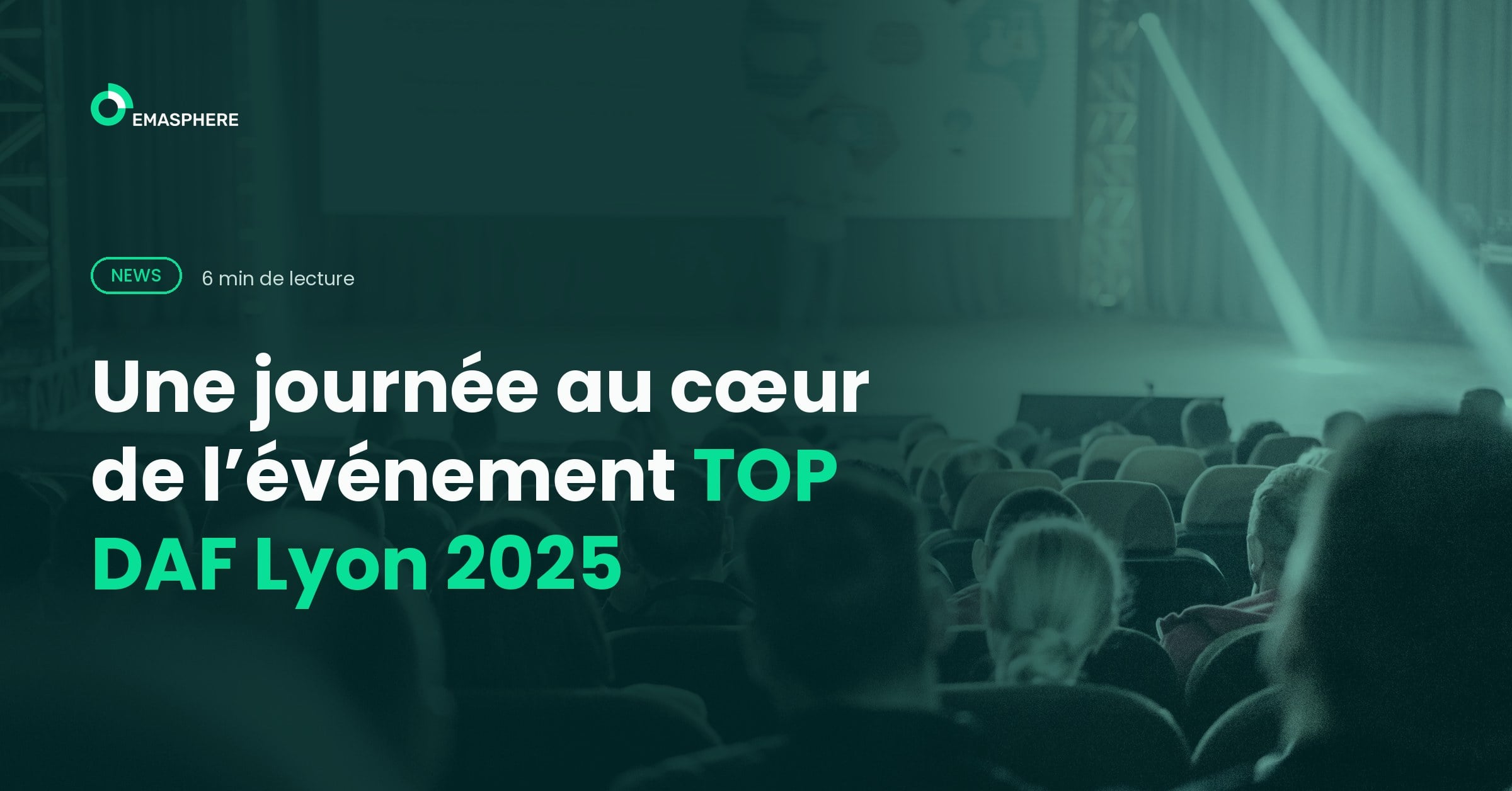
A look back at our day at the TOP DAF Lyon 2025 trade show, held at the Hôtel-Dieu in Lyon.
The 2025 Lyon edition of TOP DAF kicks off. At 7:30 a.m., the doors open onto an iconic venue: the Hôtel-Dieu in Lyon. Steeped in history and recently restored, the building hosts the key players in corporate finance for one day. A setting worthy of the topic: the future of the CFO.
1st highlight: 1:1 meetings between decision-makers and experts
The true highlights of the event, the 1:1 meetings give every decision-maker the chance to share their needs and explore the solutions best suited to their organization.
These one-on-one conversations add real value: they go beyond simple product discovery to build a personalized dialogue between finance experts and innovators.
Talking with several of the CFOs in attendance, three main motivations emerged:
- Staying informed about the latest technological innovations applied to finance functions;
- Finding concrete solutions for growth and digitalization, to move beyond the limits of Excel;
- Hearing testimonials from peers who have already rolled out new tools or processes.
At EMASPHERE, we share this conviction: peer-to-peer experience sharing is an essential lever for progress in the finance community. It's also the spirit behind our podcast, which gives CFOs a voice to talk about their challenges and successes.
On site, that same spirit came to life both in the themed workshops and in the informal conversations, the spontaneous discussions between professionals that make the TOP DAF show so valuable.
2nd highlight: workshops to fuel CFOs' thinking
Three talks particularly caught our attention. We've summarized their key takeaways below:
Talk 1: Global economic outlook and risk management
Workshop led by Coface
We attended the workshop presenting the analysis of the latest Coface barometer on the global economic outlook and economic risks in 2025-2026.
The question we explored: how can you manage financial performance and risk in an uncertain global environment, marked by trade tensions and protectionist policies?
Key points and food for thought
- Record economic uncertainty: 2025 is reaching a level of unpredictability comparable to the Covid period. Global outlooks are smoothing out, but volatility will remain high through 2026.
- US-China trade tensions: a return to tariffs not seen since the 1930s (17% on average), with a 45% tax on Chinese products. The result: higher costs for American companies and pressure on consumers.
- Indirect effects on Europe: despite inflation contained at around 2% and stable energy prices, companies face production overcapacity and shrinking margins.
- Business failures: a notable increase in Asia and Europe, particularly in France.
CFOs must therefore navigate a context of weak global growth (≈2%), structural uncertainty and heightened geopolitical risk. Forecasting and financial agility through reporting are becoming essential levers for anticipating the economic shocks ahead.
Talk 2: How do you roll out AI across your organization?
Workshop led by Adapt1 Solution
Next, we turned to a topic everyone is eager to discuss: AI. The workshop helped us understand the concrete steps for effectively integrating artificial intelligence into financial and operational processes.
It's true that you need to get organized to figure out how to move from simple digitalization to real, high-performing use of AI in the company.
Practical solutions and implementation ideas:
-
Key distinction: digitalizing = automating based on predefined rules; integrating AI = enabling the tool to learn and act autonomously.
-
Prerequisites: AI must serve a clear, measurable objective (SMART method) + map time-consuming tasks to prioritize use cases + assess data maturity: accessibility, format, reliability.
-
Rollout roadmap: POC (proof of concept) → 2. Pilot phase → 3. Scale-up. Use the effort / impact matrix to prioritize projects.
-
Example tools:
-
ScribeHow to capture and document processes.
-
ChatGPT (Enterprise version) to automate internal analyses or enrich the CRM via Make / Zapier.
-
-
Adoption best practices: favor simple, intuitive tools that spread naturally, rather than imposed ones.
This workshop echoed the mini round table held during the EMASPHERE workshop, which also looked at where CFOs stand on AI. The CFOs present were open and curious about AI, but highlighted two points of caution:
-
protecting sensitive data,
-
and the need for training to adapt AI to the finance function.
Clearly, AI is becoming a decision-support tool, not a substitute. Its value depends above all on data quality and organizational maturity.
Talk 3: How can CFOs be guaranteed reliable reporting tailored to each industry?
Workshop led by EMASPHERE
Our experts explored a topic of interest to every CFO: industry-specific reporting. How can a CFO ensure that reporting is reliable, relevant and tailored to their industry using EPM tools? That's the question we answered at a time when the CFO is becoming the CEO's copilot. It's no longer just about producing figures, but about steering performance and strategy. To do so, CFOs need reliable, consolidated data put in context for each line of business.
Solutions and best practices:
- Reliability: audited data, consolidated automatically.
- Accessibility: indicators shared easily across departments and in multiple languages.
- Relevance: KPIs adapted to the specifics of each business.
A modern EPM like EMASPHERE makes it possible to centralize data from all business software, automate multi-entity consolidation and give CFOs a real-time view of performance, while freeing up time for strategic analysis.
And we were delighted to welcome two of our customers:
- Marie-Christine Condemi, CFO of the Pascal Coste group, which runs a network of more than 300 hair salons, shared her hands-on experience:
"For us, each salon is a profit center in its own right. EMASPHERE has made things simpler: we can present consolidated reporting for all our salons, even though they have different structures."
In just a few sentences, she sums up the key gains: reliability, speed and, above all, time freed up to focus on strategy rather than producing figures. "I no longer spend my time building my reports, but analyzing and interpreting them and helping drive sales."
She adds: "We can drill down to the individual accounting entry. Once the data is collected, it's formatted and remains fully accessible."
- Naïma Chalh, CFO of Mutual Logistique, shares the same satisfaction: "The day before a management committee meeting, preparing the files used to be tedious. Today, I simply switch between filters to view results by site. I've saved a huge amount of time and I no longer worry about a formula being copied wrong in Excel."
This feedback points in the same direction: automation, reliability and agility are the watchwords of reporting. EMASPHERE is becoming a true copilot for CFOs who want to shift from producing numbers to analyzing them.
3rd highlight: informal conversations at the heart of a community
If the TOP DAF show has become a must-attend event, it's also thanks to its friendly atmosphere and human scale. Between meetings, meals and breaks in the October sunshine, the conversations flow. CFOs share their best practices, their doubts and their ambitions for the years ahead. One question comes up often: how will our role evolve by 2026?
To keep the conversation going, EMASPHERE and TOP DAF are launching an exclusive survey: the CFO of 2026 facing AI, digitalization and new challenges. This study aims to identify CFOs' priorities and expectations, so that together we can sketch the profile of tomorrow's CFO.
You can take part today in just 5 minutes:
The results will be published in December 2025 and shared in advance with participants from November.

Rather talk it through with a human?
A first conversation, with no commitment, to see what your reporting could become.