
6 January 2022 · 6 min read
How can a finance team keep pace with hypergrowth? Nicolas Moinet, management controller at Exotec, shares the habits that keep the finance function agile.
How the finance function of an SME in hypergrowth stays agile in the face of rapid development.
Working in the finance department of an SME in hypergrowth is a rewarding experience, synonymous with rapid development and structuring. These scale-ups share an obvious common denominator: the need to move very fast. This is why agility becomes key to supporting the rapid evolution of these organizations.
Jean-Charles Hebbelinck, Regional Manager at EMASPHERE, co-hosted a workshop on this topic when EMASPHERE took part in Financium, an event organized by the DFCG.


Left: Jean-Charles Hebbelinck (Regional Manager at EMASPHERE).
Right: Nicolas Moinet (Management controller at Exotec).
During this workshop, Nicolas Moinet, management controller for the past two years at Exotec, shared his experience. Exotec is a scale-up in hypergrowth that specializes in robotic logistics solutions. Since it was founded, the company has produced 300 robots.
At the end of 2021, this remarkable scale-up had 360 employees spread across its different entities (France, Germany, Japan and the USA). Its revenue doubles every year, and its revenue forecasts for 2021 add up to 100 million euros… Exotec is definitely a company in hypergrowth! This remarkable growth was backed by a 90 million euro funding round in 2020. The company stands out for the variety of profiles that make it up (regional managers, investors, plant directors…). To keep up with this growth and give everyone an up-to-date view of the company's results, Exotec's finance team set out to digitalize its processes. Thanks to EMASPHERE, it was able to offer reports that:
- deliver just the right amount of information;
- adapt to users' needs;
- and above all, spark their curiosity.
In concrete terms, how has Exotec's finance team supported this hypergrowth over the past 2 years? What processes and tools has it put in place to secure the scale-up's long-term future? What habits has it adopted to manage its group effectively? Nicolas Moinet answered all of these questions at the event.
During the workshop, Nicolas Moinet presented to participants what he sees as the main elements required to make a finance department more agile. Based on his experience, 4 points deserve particular attention:
- centralizing data;
- automating consolidated reporting;
- sharing information;
- anticipating the group's future.


Centralizing your data
Best practices
With digitalization on the rise, most finance leaders have become aware of what is at stake with data centralization. It is crucial to take this into account, especially since some company departments use several software tools on their own.
This observation is shared by a large part of our community of 10,000+ customer companies. To meet this need, EMASPHERE connects to the company's software through its 60+ connectors. The platform collects financial and non-financial data and centralizes it. It then offers a reporting solution that adapts to each user's specific needs.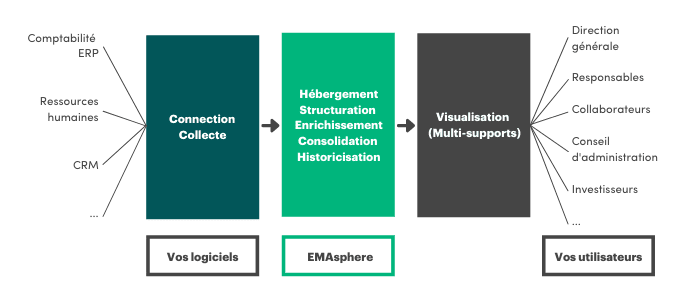
Overview of how EMASPHERE works, from collecting data
in existing systems to distributing tailored reports.
How Exotec centralized its data
Nicolas Moinet quickly turned to how Exotec centralized its data. He explains how he went about it with EMASPHERE:
We connect our largest source of information, our ERP, directly [to] EMASPHERE. We already had a connector for our ERP, which we very quickly adapted to extract the information we needed.
Exotec has seen significant time savings when setting up reporting for its new entities. Once the ERP is in use at the new entity, all it takes is connecting that entity's data flow in EMASPHERE.  Reports can also be set up quickly when entities use different charts of accounts. This is made possible by the platform's account categorization feature.
When he joined Exotec, Nicolas had to deal with tedious, cumbersome Excel files. That is now a thing of the past thanks to EMASPHERE:
Our activity reports [are developed] both with the EMASPHERE teams [and in-house]. The EMASPHERE team [gave us] the skills to modify, adjust, adapt and create any type of report.
This significant improvement came quickly:
In less than two months, we were autonomous [with the solution] and [were able to] start developing reports for our various stakeholders.
Automating consolidated reporting and tracking the KPIs that matter
Automation is also a key part of agility: why repeat the same manual tasks every month? For Exotec, the objective was clear: automate the updating of its reporting.
Another of Exotec's challenges lies in opening new entities. Since the scale-up opens an average of one new entity every year, it is easy to see why. Exotec quickly realized it was crucial to find a reporting solution able to adapt to its very fast-changing consolidation needs. Nicolas explains how:
The advantage of EMASPHERE is that we can integrate a new entity very quickly, capture its financial flow and add it to the reporting. (...) One week of work and it's done.
Nicolas also goes into detail on the indicators Exotec tracks most closely:
Above all, we track growth profit by region (...), which is hotly contested among our regional directors, whether YtD or in the reforecast for full-year landings. Another indicator that gets a lot of attention from an HR perspective [is] of course activity growth and the forecast of human resources needs. [This indicator] challenges our hiring, which today is one of the keys to our success.
Sharing information
Reports to distribute across several entities, to different stakeholders, in multiple currencies, and in a format and timeframe that meet investors' requirements: Nicolas's job at Exotec is a big one.
Sharing financial information within the company should not be complicated. On the contrary, this information should tell the company's story… And just like a story, financial reporting needs to be easy to understand and take ownership of.
Nicolas explains:
Now, directors have much more time to ask questions before they get to the Comex and each present their part. (...) You can feel that it has changed things in terms of (...) the financial curiosity [of very operational profiles].
Anticipating the future of your group's activities
Nicolas Moinet is clear on this: relying on financial and non-financial data to understand the past is always insightful. Yet the Exotec example also highlights the importance of looking ahead.
The ability of an SME or scale-up in hypergrowth to build several forecast scenarios is decisive. Nicolas Moinet's experience proves it: anticipating the future is the cornerstone of well-managed hypergrowth. Here is how Nicolas made the most of the scenario tool offered by EMASPHERE:
Today we have several scenarios. A first scenario, which is your budget or your target and which will be available in all your reports. You can make comparisons (...) based on the axis you choose (for example, your cost center or your regional business unit).[A second scenario, where] you can create different reforecast scenarios per company, with a more or less optimistic or more or less pessimistic scenario. [And finally a scenario] that seems most realistic to you.
You can build these scenarios company by company, or cost center by cost center... The advantage of EMASPHERE is that it compiles [these scenarios] and makes them all available to you in your reports.”
Conclusion
In short, Nicolas Moinet's department became more agile by choosing an intuitive, scalable reporting platform. EMASPHERE gives Exotec the levers it needs to move forward quickly and confidently on topics typical of SMEs in hypergrowth, such as:
- greater accuracy despite an increasing number of data sources to manage;
- scalable multi-entity consolidation;
- support for multiple currencies;
- automatic elimination of intercompany transactions;
- steering strategic decisions based on financial and non-financial data (for example, hiring).



Rather talk it through with a human?
A first conversation, with no commitment, to see what your reporting could become.