
14 March 2019 · 9 min read
Follow our 5 tips to optimize your company's cash flow: inventory, customer receivables, spending control, financing, capital and more. Follow the guide!

Cash is the amount of liquid funds a company has available at a given moment. Cash is essential to a company's viability: it is what pays salaries, suppliers, operating costs, investments, and more.
In the current context of rising inflation (+12.27% in October 2022), the need for a real-time reporting solution is becoming clear. Given the rising prices of energy, raw materials and payroll in particular, it has become important to see your financial figures at a glance, such as cash, forecasts and cost analysis.
Cash is one of the leading indicators of a company's health. If it is not properly monitored, it can put your company in trouble. In accounting, it corresponds to the financial resources needed to cover a company's working capital requirement (WCR), that is, disbursements minus receipts.
Discover the 7 keys to optimizing your cash flow

With this ebook, learn how to optimize your cash management from a practical standpoint, which KPIs to track and which concrete improvements to put in place.

A lack of cash is a recurring cause of bankruptcy. Even companies with high revenue are not immune. Bankruptcy can happen when, for example, suppliers must be paid while many customer payments are still outstanding. To avoid this situation, you can take several actions to optimize your cash management. We have grouped them into 5 tips:
- Optimize your inventory management;
- Reduce your customer receivables;
- Control your spending;
- Anticipate your banking situation;
- Increase your capital.
First things first...
Good cash management is a long-term effort. Before making corrections or optimizations, get a complete view of your cash position, both current and upcoming. To do this, it is important to set up a cash flow forecast. The goal is to see your upcoming expenses (disbursements) and income (receipts). This way, you can anticipate future cash needs. Here are a few key elements for building the most accurate cash budget possible:
- customer and supplier payment terms;
- tax payment dates;
- payroll dates;
- social security contributions;
- ...
Also, make sure you update your cash flow forecast regularly (ideally every month). This careful monitoring will help you handle potential surprises as well as possible.
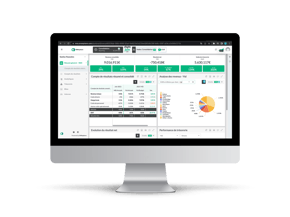
In addition to your monitoring, dedicated tools give you an instant, up-to-date view of your cash position. They also spare you from using Excel files, which are both tedious and error-prone. Beyond immediacy, these tools usually let you create several forecast scenarios so you are ready for any eventuality.

Tip 1: Optimize your inventory management
From a cash perspective, inventory represents tied-up money, as well as storage costs. Optimize your inventory management and find the right quantity of products to keep in stock. The goal is to avoid both overstocking and stockouts. To avoid these situations, here are the interdependent factors to analyze and improve.
Keep an eye on stock quantities
A first area for action is the quantity you keep in stock. To optimize your inventory, carry out a stock count. Your goal is simple: compare stock quantities with sales needs and supplier lead times. For example, there is no point in stocking large quantities of products that suppliers can deliver quickly. The same applies if storage costs more than buying the products.
Choose the right turnover rate
The inventory turnover rate can also be a lever for improvement. If a product stays in stock for a period well beyond its delivery lead time, ask yourself whether it would be commercially acceptable not to keep it in stock. If so, it is probably wise to order it only when a sale is made.
Improve your delivery lead times
Shorter delivery lead times reduce stock quantities, and therefore the amount of cash tied up. This topic should be discussed regularly with the suppliers or service providers in charge of deliveries. Let's take an example. If you cut delivery lead times from 3 to 2 weeks, this also affects the stock you need (excluding safety stock). In this example, stock covers 2 weeks of activity instead of 3, a 33% reduction.
Keep in mind, however, that this factor must be analyzed in light of any cost increases. Costs may indeed rise because of shorter delivery lead times and more frequent handling.
Reduce storage costs
Finally, it can pay to reduce the costs directly related to storage. If you have outsourced your storage to an external provider, putting the contract out to tender could reduce costs in the medium term.
Tip 2: Reduce your customer receivables
Healthy cash flow also depends on reducing customer receivables. You can achieve this reduction in several ways, such as analyzing creditworthiness or shortening payment terms...
Run credit checks
Some business transactions tie up a significant amount of cash. For these transactions, you may need to make sure the customer is creditworthy. Depending on the customer's credit score, the payment terms you grant can be more or less strict. You can then relax these terms once a relationship of trust is established.
Tools exist to make verifying this information easier. They give each company a rating based on about ten criteria covering:
- legal information (legal form);
- financial position (financial statements, income statement, balance sheet);
- reputation.
Optimize payment terms
Several tactics can help you optimize payment times for customer invoices:
State your payment terms
The first step is to state the payment terms clearly on the invoice and include your general terms and conditions of sale. You can add information such as:
- the payment due date (e.g. payment upon receipt of order, payment at 30 days, etc.);
- bank details;
- penalties for late payment;
- fees for collection costs;
- ...
The last two points are usually not enforced for commercial reasons. Nevertheless, they have the advantage of acting as a deterrent and encouraging customers to pay on time.
Note that, when it comes to payment terms, asking for deposits also helps protect your cash. This is especially true for orders with long manufacturing and/or delivery times. These orders can tie up significant internal resources, subcontractors or suppliers.
Automate invoice reminders
Automating invoice reminders is also a good way to reduce late payments. Customers usually wait until the last moment to pay (because they also want to optimize their own cash). Schedule a reminder to be sent a few days before the payment due date. This creates a sense of urgency and may encourage them to pay on time. Our recommendation is twofold:
- schedule a reminder of the due date;
- then another one a few days after the first reminder.
A simple phone call can also help unblock the situation. Note that invoicing software can automate sending invoices and reminders. It saves you time and keeps your invoicing up to date.
Raise awareness in other departments
Draw other departments' attention to cash issues. For example, the commission plans set up for some sales teams may not take payment into account. In this situation, employees get paid even if the customer does not pay their invoices.
Consider factoring
If the strategies above do not work, or only partly, there is another solution: factoring. This method consists of handing unpaid invoices over to an external company in exchange for immediate payment, with no collection delay. In return for the risk taken, the factoring company (called the "factor") deducts a percentage of the amount paid as its fee. Although costly, this solution is a good way to make sure you quickly receive part of the money you are owed.
7 mistakes to avoid for successful reporting
✅ Every finance professional has made a reporting mistake at some point. Thanks to our more than 10,000 customer companies, we have compiled the most common mistakes for you.
❌Never make a mistake again by downloading this free ebook.

Tip 3: Control your spending
Optimizing your cash flow is not just about increasing the money coming into the company. It also means controlling, reducing, postponing or canceling certain expenses.
Centralize your purchasing
Setting up a purchasing policy starts with centralizing purchasing in a single place. This organization helps you understand the nature and frequency of each department's spending. With this understanding, you can then map and optimize these expenses. Some costs will probably appear several times, but at different rates (e.g. regular transport between two company offices). These costs affect cash, so you should try to rationalize them.
Centralized purchasing lets you group orders whenever possible (to achieve economies of scale). It also gives you a complete view of the company's suppliers and can therefore help you renegotiate your contracts.
Analyze your overhead
To optimize your cash flow, you should also analyze your overhead. Two questions can be asked:
- Is this expense necessary?
- Is there a cheaper alternative with the same level of quality?
At first glance, this may seem very complex. Yet this technique helps you stay focused on the most important expenses (in terms of value for the company).
Reducing the time spent on time-consuming tasks also helps improve your overhead. Rely on tools that can automate your sales process, accounting or expense reports. This will help you:
- save time;
- improve team efficiency;
- optimize your costs.
Renting supplies, equipment and real estate is generally more expensive than buying. However, renting is a good way to spread out expenses and keep your cash for other operations.
Finally, it can be helpful to review upcoming expenses and postpone some of them to have a positive impact on cash.
 "Thanks to the drill-down feature, which lets you go into the
Alain Etienne, Co-founder of Kazidomi
Discover how Kazidomi got its costs under control with EMASPHERE →
Optimize supplier payments
Depending on your bargaining power with suppliers, you may be able to negotiate several elements that can have a positive impact on cash:
- price discounts;
- longer payment terms;
- installment payments;
- early payment discounts;
- ...

Tip 4: Anticipate your banking situation
Involve your bank
Your bank can be a key player in a strategy to improve your cash flow.
A bank overdraft can be used for one-off cash needs. Quick to set up and very useful over a short period, this solution is nevertheless costly in the long run.
Bank discounting is also worth considering for short-term liquidity needs. It works on the same principle as factoring. The difference lies in who pays: the bank instead of the factor.
Finally, consider a bank loan. Based on your cash flow forecasts, you can anticipate difficult periods. This way, you can negotiate attractive overdraft or loan terms in advance. The loan is then taken out while the company's finances are positive, and its terms will be better.

Tip 5: Increase your capital
Make an internal or external contribution
Capital increases can help you in 2 situations:
- to grow the company (external growth, opening a subsidiary, launching a new product, etc.);
- to improve its financial position.
This capital increase can come from an internal contribution (by the partners) or from opening up to external investors. This operation, whose effects are not immediate, is not always simple. It may involve diluting the partners' shares. It is also subject to certain conditions, depending on the company's legal form (SARL, SAS, etc.).
Conclusion
Optimizing cash flow starts with building forecasts. This anticipation makes it easier to identify the decisions to make and the actions to take:
- optimizing inventory;
- increasing capital;
- managing customer receivables;
- negotiating supplier terms;
- ...
Once its cash position is thriving, what can the company do? Of course, it is important to keep a healthy cash level to cover unexpected events. But there is no point in keeping a large cash surplus, since it earns nothing. Several options are then available to you: internal investments, financial products, company acquisitions, and more. Choose your company's type of investment based on its strategy, risk tolerance and expected level of return.
Stay in control of your cash with EMASPHERE
 📊 Automate your cash reporting
💰 Quickly determine your cash needs
📈 Choose your liquidity KPIs from a catalog of KPIs





Rather talk it through with a human?
A first conversation, with no commitment, to see what your reporting could become.