
4 November 2021 · 8 min read
What makes good reporting for a board of directors, and how do you build it? Get our answers, plus generic and industry-specific board reporting examples.

Are you as short on time as the members of your board of directors, yet still want to give them accurate, high-quality reporting? This article is for you!
Once you have read it, you will be able to provide your board of directors with reporting that is efficient, actionable and well structured.
To help you produce reporting for your Board of Directors efficiently, we will cover:
- the building blocks and pitfalls of this type of reporting;
- board reporting examples (generic and industry-specific) to inspire you;
- our methodology for creating a dashboard, based on expertise gained with our 10,000+ customer companies.

How can you share your reporting with your board of directors effectively?
What makes good reporting for a board of directors?
Good reporting for your board is a bit like a well-chosen gift: it meets the needs, habits and preferences of the person receiving it. A gift your aunt will love won't necessarily please your brother... The same principle applies to reporting! Reporting designed for the executive committee won't necessarily satisfy the board of directors. That's why it is important to share reporting that is dedicated to them.
Reporting for a Board should be:
- concise;
- visual;
- contextualized;
- regular.
It also goes without saying that your choice of reporting tool deserves careful thought.
Concise reporting
Most of the time, the members of a company's Board:
- are short on time;
- don't necessarily have a finance background;
- care more about a macro view than a micro view of your activities and performance indicators.
That's why the key performance indicators (KPIs) you give them must be chosen carefully. Go for a short but relevant selection that is actionable and specific to your industry and/or business model, rather than a generic, exhaustive list.
The purpose of your board meetings is to steer your company's strategy. To do this, your Board members rely on the reality of your business (performance, competition, circumstances...). So you should give your directors a complete overview of your company.
Visual reporting
Data visualization is one of the must-haves of your board reports.
Visuals are a great replacement for hard-to-digest tables. They are the best friend of people who are short on time and/or outside the company's day-to-day life. Some directors have everything to gain from this type of presentation.
Ultimately, the whole Board understands reports faster when they are presented visually rather than as long, linear documents.
Contextualized reporting
As mentioned above, board members may be external to the organization, or focused on their day-to-day operations when they are part of it.
That's why it is essential to put the data in your reports into context.
To do this, you can adopt two habits:
- add comments;
- provide a comparative view that tracks how your performance indicators evolve (for example, one that includes a comparison with the data from the previous report).
We recommend this practice because it frees up valuable time for your board members. When you work this way, they no longer have to dig up historical data themselves.
 This attention to ease of use can also smooth your relationship with your Board.
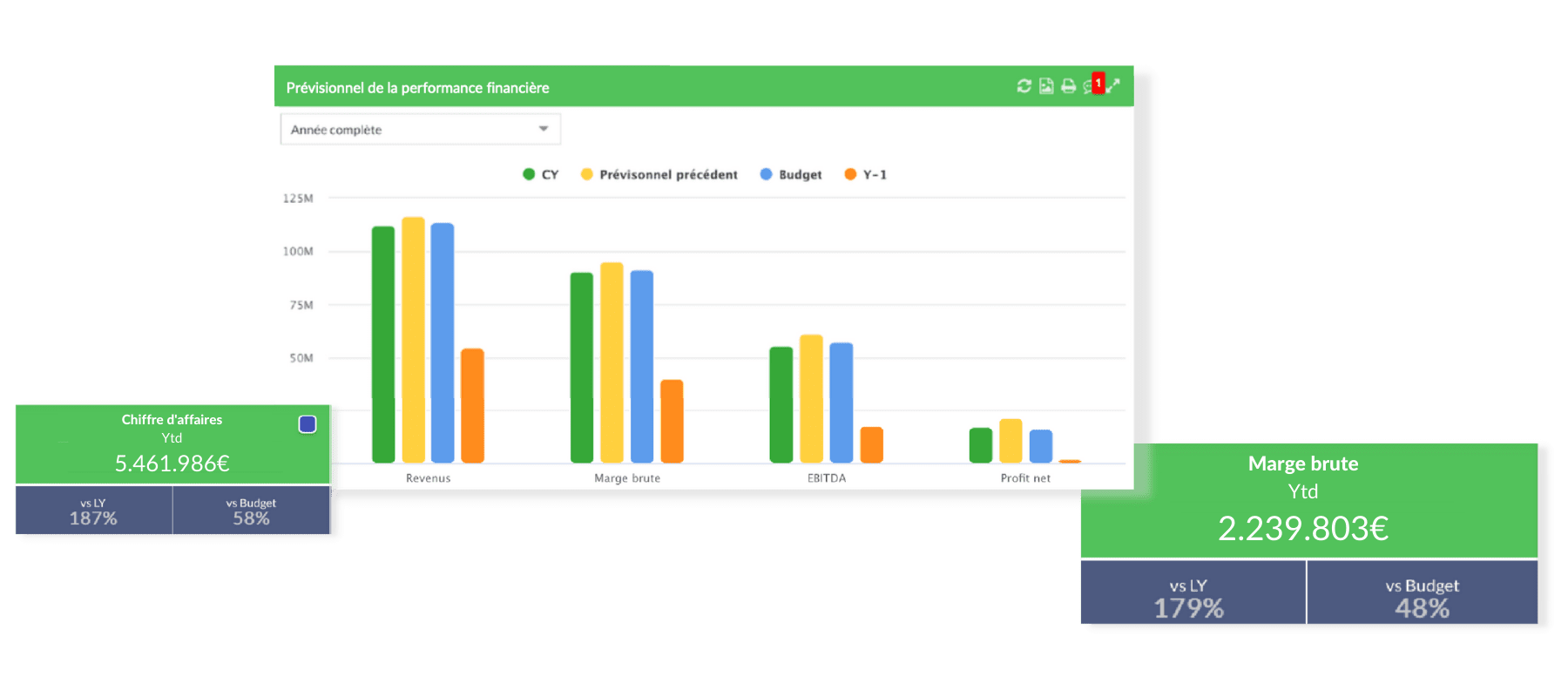 An overview of what EMASPHERE offers for contextualizing the information presented to board members. This overview is available, among other things, through the personalized platform access that board members can be given. The values shown are based on fictitious data.
Regular reporting
Depending on your industry, your business model, your Board members' preferences and how often your company holds board meetings, set the frequency at which you issue your financial dashboards. Usually, this frequency matches the board meeting schedule.
On top of that, you can give your board members more autonomy. For example, you can let directors access their dedicated reporting whenever they want, on the device of their choice (computer, tablet, smartphone...). Just make sure the data is accurate at all times and updated regularly.
 An overview of the EMASPHERE platform on its different devices.
You can also adapt your Board reporting to the circumstances. For instance, your board members may want different reports for:
- the Annual General Meeting (AGM): usually held once a year, it covers standard, recurring topics.
For example: approving the annual accounts.
- Extraordinary General Meeting (EGM): held when important decisions must be made without delay. It is therefore exceptional.
For example: for decisions typically made at an EGM, such as the strategic pivots needed after a sudden market shift, a crisis, etc.

Which tool should you choose to deliver reporting to your board of directors?
We discussed the criteria for Board reporting above: it should be concise, visual, contextualized and regular. But how do you produce it efficiently? By choosing the right tool.
While researching, you may have considered Excel and its charts... Before remembering the risk of errors it exposes you to... So which tool should you choose?
To meet the criteria for board-ready reporting, your tool must make it easy to create and share your Board reporting. To that end, it is important that the tool is:
- easy to use and flexible;
- compatible with the systems you already have in place (accounting software, CRM, HRIS...) so it delivers reliable, regularly updated data;
- able to provide differentiated access for each person, and a personalized dashboard dedicated to the board.
To meet these criteria, we recommend using a performance management platform such as EMASPHERE. And for good reason: this type of solution supports you in every aspect of reporting to the Board.
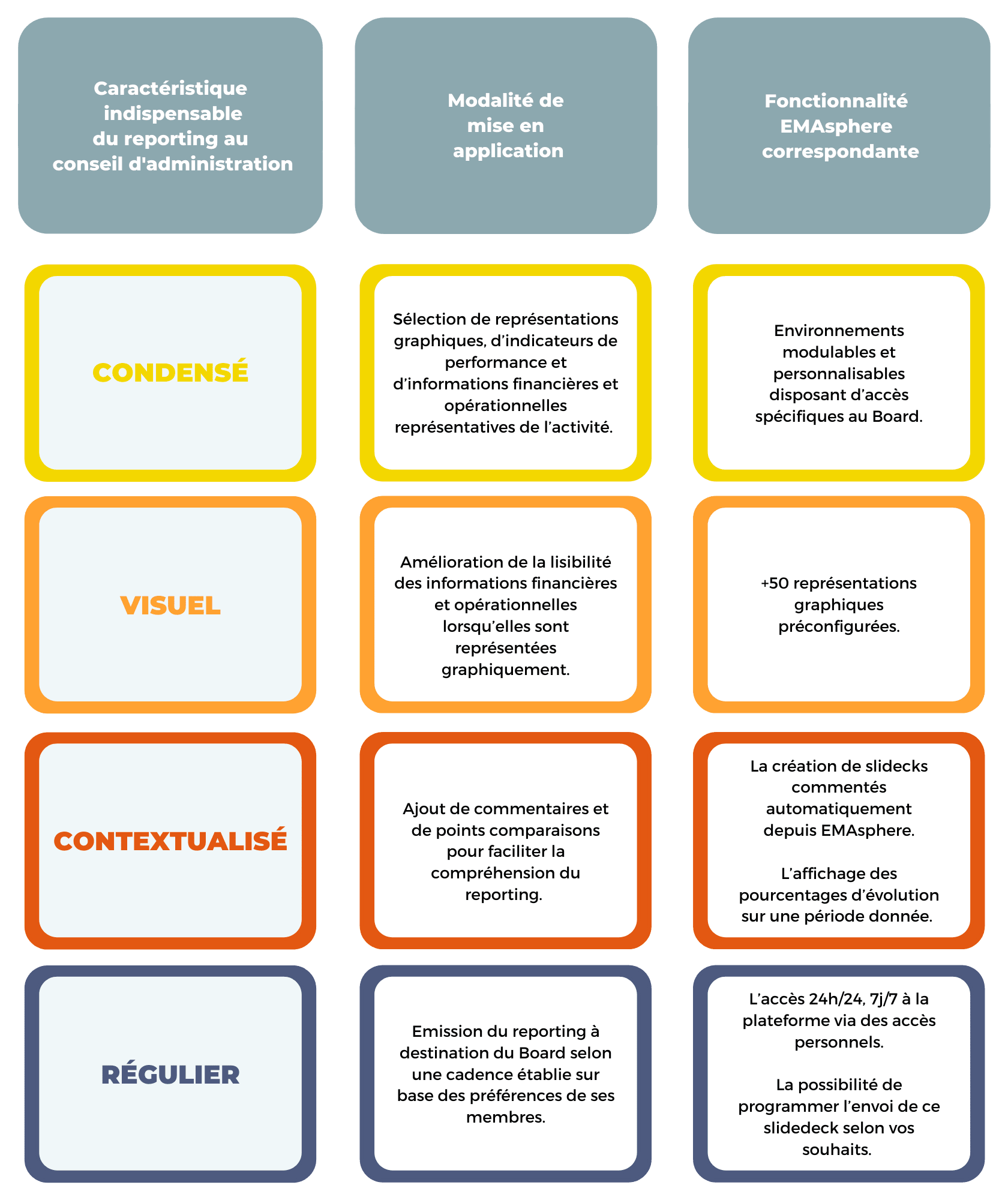
The table of key elements for Board reporting matches the features offered by EMASPHERE

Board of directors reporting examples
This selection of Board reporting examples is based on our experience with our 10,000+ customer companies from a wide range of industries.
It is not meant as a recommendation or an absolute standard, but rather as a source of inspiration to help you put together your board reporting.
Keep in mind that you should always adapt your reporting:
- to its users;
- to your company's particularities;
- to your company's level of maturity;
- and to the specifics of your business model and/or industry.
To go straight to the type of reporting you are interested in, click the section of your choice below:





Generic reporting example
For this report, we will focus on the fundamentals of company performance.
The essential KPIs include:
- EBITDA;
- revenue;
- ROE (Return on Equity);
- cash balance;
- working capital requirement (WCR).
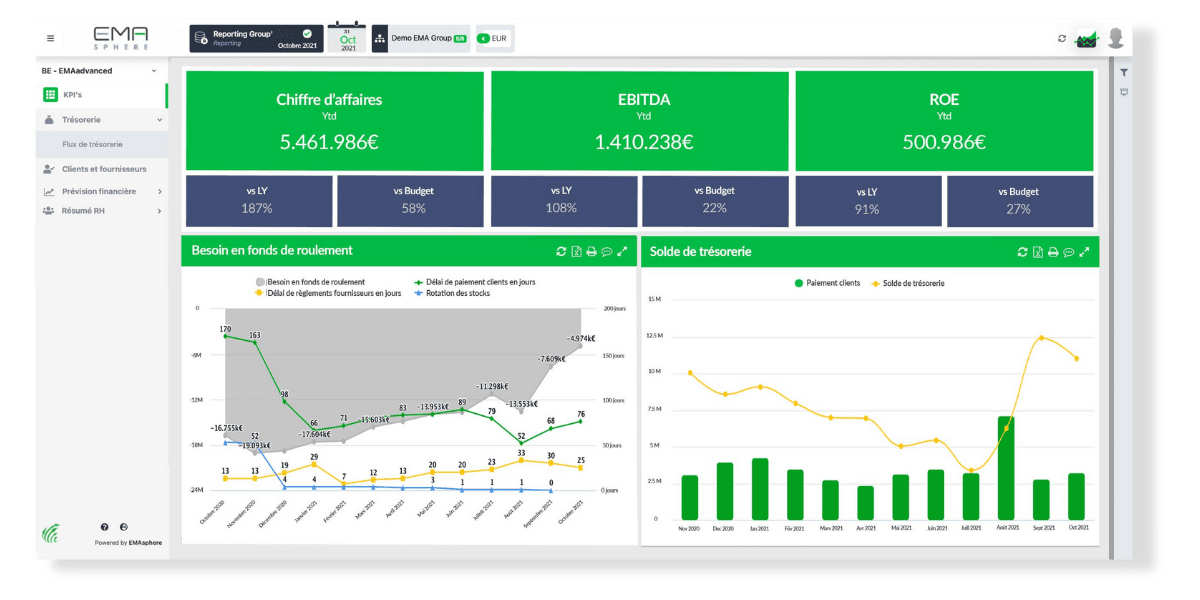
An example of generic reporting built in the EMASPHERE platform, based on fictitious data.
Also track your analytical P&L and cash flow, as well as some forecast information.
Reporting example for a services company
Based on what we have learned supporting our customers in the services industry, we recommend that your services company's board reporting includes elements related to:
- your business model;
- annual value of signed contracts (ACV, or Annual Contract Value),
- profitability per hour worked;
- your activity;
- number of hours delivered,
- hours worked vs. hours paid,
- hours worked per client / project;
- your revenue and sales;
- your human resources department;
- tracking of expense reports (meals, client travel...).
Who better than a services company to talk about EMASPHERE to another services company? In its testimonial, business consulting specialist Peers Group explains how it freed its 9 subsidiaries from Excel.
Reporting example for a SaaS company
Our own experience as a SaaS company reporting to its Board leads us to recommend that your SaaS company's reporting includes elements specific to:
- your business model;
- MRR (Monthly Recurring Revenue),
- ARR (Annual Recurring Revenue),
- MRR and ARR by user segment (for example: which type of company generates the most revenue?),
- MRR breakdown by subscription plan;
- your profitability;
- CAC (customer acquisition cost),
- ROAS (Return on Ad Spend),
- LTV (Lifetime Value, or customer lifetime value);
- your customer relationships;
- churn rate (also known as attrition rate),
- NPS (Net Promoter Score).
Does your company sell a SaaS product? Get inspired by the real-life example of our customer Urbantz. Discover the metrics this logistics SaaS start-up tracks in their testimonial.
Reporting example for a retail company
Based on the experience gained with our retail customers, we recommend including in your board reporting elements that are relevant to:
- your business model;
- analytical revenue (store, product range, collection, product type),
- DPO,
- average basket value;
- your profitability;
- analytical gross margin (store, product range, collection, product type),
- net margin in absolute value,
- net margin in absolute value and as a percentage per point of sale;
- your foot traffic;
- number of customers per month (vs. LY) per point of sale,
- purchase frequency (also known as repeat business);
- your human resources;
- staff costs,
- staff turnover rate.
How do you track the right KPIs and get automatically updated data when you run several points of sale? Biscuit maker Maison Dandoy explains how it achieved highly granular tracking of its retail activities.
Reporting example for a construction company
What we have learned from our work with construction companies leads us to recommend structuring your board reporting around elements covering:
- your business model;
- Revenue by program, project, property type,
- DPO/DSO,
- top suppliers,
- cost details by subcontractor, machine, materials...;
- your liquidity needs;
- current ratio,
- days of liquidity;
- your use of leverage;
- revenue-to-equity ratio,
- asset turnover;
- your profitability;
- per job site,
- per property type,
- per construction division;
- your human resources;
- hourly cost,
- details of workplace accidents.
What do our customers say about our offering for construction professionals? To find out, read the testimonial from builder Etienne Piron about the competitive edge it gained with EMASPHERE.
As mentioned earlier, this article focuses mainly on sharing relevant dashboards with the board of directors. However, sharing dashboards is only part of what is discussed at board meetings.
For example, the following points are often covered at board meetings:
- a review of the actions implemented since the last board meeting;
- a review of the company's activity and finances (broken down by quarter) using the dashboard;
- various topics related to the company's specific situation.

Use an effective method to create your board of directors dashboard
To learn all about our simple, actionable method, check out our ebook on building dashboards.
In three simple steps, you too can learn to create your dashboard successfully! What's inside:
- identifying needs;
- designing the dashboard;
- analyzing and processing data...




Rather talk it through with a human?
A first conversation, with no commitment, to see what your reporting could become.